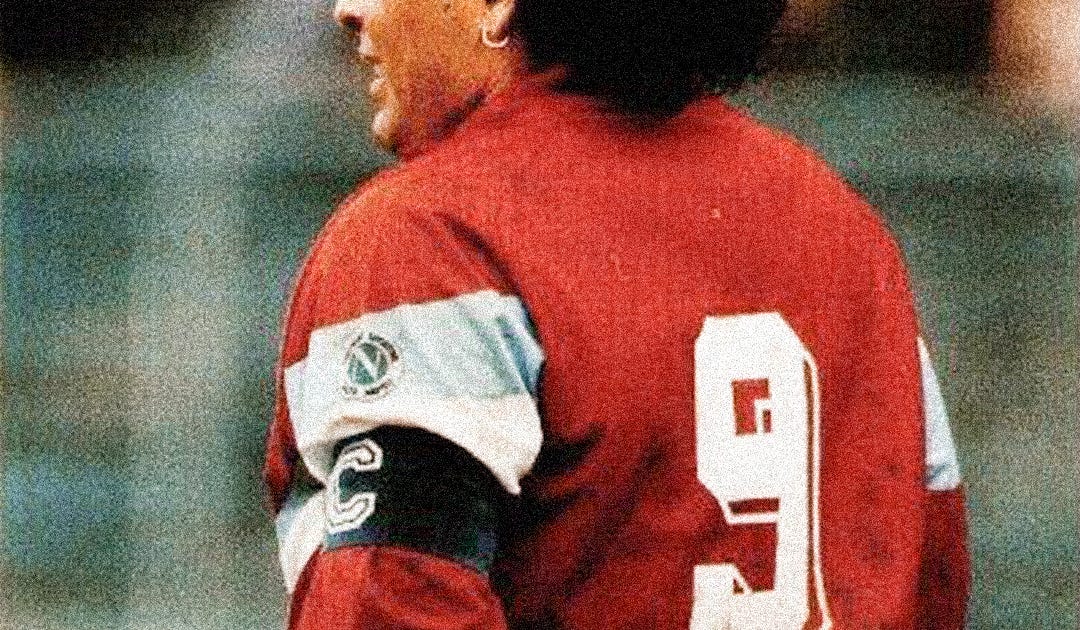
The Number Nine

There is a certain silence that arrives before something ends.
In February 1991, that silence travelled with Napoli to Pisa. The air felt different there, thinner, sharper, carrying a cold edge of salt that did not belong to Naples. It settled lightly on the skin, but it stayed, lingering in a way that made the distance between the two cities feel greater than geography.
Before kickoff, Romeo Anconetani walked the perimeter of the pitch with slow, deliberate steps. His hands dipped into buckets, lifting handfuls of salt and scattering them across the grass. It was not decoration, nor superstition in its usual form, but something closer to a boundary, an attempt to fix the space before anything within it could begin.
When the tunnel opened, Napoli emerged into that air in familiar shape. Familiar movements, the outline of something that had already existed for years. And yet, almost immediately, something resisted recognition.
It was the number.
Maradona stepped onto the pitch wearing 9.
For a moment, nothing else changed. The body remained the same, as did the way he carried himself, the quiet gravity that followed him across the pitch. But the number did not dissolve into the rest of the image. It stayed visible, fixed, asking to be noticed.
The 10 had not been lost. It had been left behind, placed onto the shoulders of Gianfranco Zola, where it sat with a weight that had not yet settled. In its place, the 9 appeared, not as a substitution, but as a shift in function. It is a number that asks for presence rather than freedom, for contact rather than distance, for repetition within confined space rather than movement across it.
On him, it sat differently.
Not incorrectly.
But without belonging.
The match unfolded without ever fully becoming itself. Passes connected, then slowed; movements began, then hesitated. The pitch felt altered underfoot, dry and brittle, as if something had been laid across it that changed its response in ways too subtle to name directly.
The salt remained.
Not visibly, but in the rhythm of the game, in the way space held instead of opening, in the way movement met resistance rather than expansion. Maradona moved through it rather than shaping it. The space no longer bent around him; it remained fixed, allowing him to pass, but not to transform it.
He was still present.
But no longer central in the same way.
The scoreline settled at 1–1, though it never felt like a conclusion. Nothing resolved itself. The match did not end so much as reach its limit, as if the conditions that held it together could no longer sustain anything further.
Beyond the pitch, the Tower leaned as it always had, its imbalance long since accepted as part of its form. It did not collapse, but neither did it correct itself. It remained suspended between what it was and what it should have been.
On the grass, something similar had begun.
The shift was small, almost imperceptible, but it was there: a number changed, a weight redistributed, a space that no longer moved in the same way it once had.
The shirt remained blue.
But something inside it had already begun to disappear.