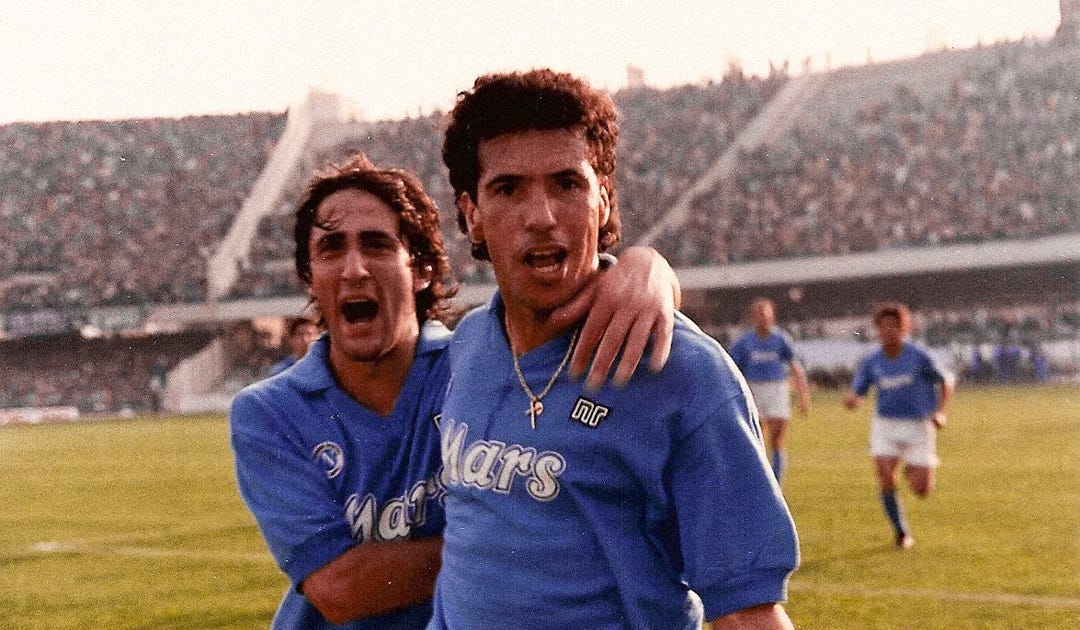
The Space Before the Pass

There are some players you remember by image.
Others you remember by sound.
Careca belongs to the second kind.
Long before the ball reached him, before the net rippled or the Curva exploded into blue smoke, there was always the same noise. A sudden intake of breath spreading across the San Paolo like a wave. Eighty thousand people recognizing, almost simultaneously, that something had just opened.
Not a gap.
A possibility.
That was Careca.
Antonio de Oliveira Filho arrived in Naples during the humid summer of 1987, when the city was still learning how to carry happiness. The first Scudetto had altered the emotional rhythm of Naples. For generations, football had been survival. Suddenly it had become expectation.
Maradona had already changed history.
What Napoli needed now was someone capable of keeping pace with it.
Careca arrived from São Paulo carrying none of Diego’s mythology and none of his noise. There were no declarations. No grand performance. Just a centre-forward whose football seemed to exist one second ahead of everybody else’s.
Watching old footage today, what stands out isn’t simply the goals.
It’s the movement before them.
Italian football in the late 1980s was built on certainty. Defenders occupied space with authority, lines stayed compact, matches unfolded like carefully argued debates.
Careca treated those certainties as temporary suggestions.
He ran diagonally when others ran straight. He accelerated into spaces that looked completely empty until Maradona’s foot transformed them into passes. His stride stayed unusually low to the ground, almost gliding without ever appearing elegant. There was violence inside the smoothness, the quiet certainty of a man who already knew where the ball would arrive before anyone else had accepted it existed.
Football often celebrates the pass.
Careca celebrated the second after it.
That was where he lived.
People remember Ma-Gi-Ca as though it were simply three extraordinary footballers sharing the same pitch.
It was something more delicate than that.
Giordano interpreted space.
Maradona invented it.
Careca occupied it before reality had caught up.
There was no hierarchy inside those movements, only instinct. Diego never needed to point. Careca never needed to ask. Somewhere between them existed a private language spoken at full speed beneath the floodlights of Fuorigrotta, invisible to everyone except the two men creating it.
Some partnerships in football are built through repetition.
Theirs felt like recognition.
The goals reflected that.
A chipped pass dropping impossibly between defenders.
A run beginning before the defender had even turned.
A right foot meeting the ball almost without breaking stride.
Then came the sound.
Not celebration.
Impact.
The old San Paolo goals had a particular voice when struck cleanly, the metal supports sending a sharp metallic crack around the stadium before the roar swallowed everything else. It was football at its most physical. You didn’t just see Careca score.
You heard friction.
Yet perhaps the most remarkable thing about Careca was the life he chose inside Maradona’s shadow.
Many extraordinary players disappeared beside Diego.
Not because they lacked ability, but because Naples revolved around him with such gravitational force that everything else risked becoming invisible.
Careca never fought that gravity.
He understood it.
He allowed Maradona to remain the miracle while quietly becoming the mechanism that made miracles repeatable. He didn’t demand attention because he had already mastered something more valuable: inevitability.
Every great act of improvisation requires someone capable of recognising it before everyone else.
That was Careca’s gift.
And when the golden era began to fracture, when Diego departed and the city struggled to imagine itself without its impossible number ten, Careca remained.
He accepted the captain’s armband without changing who he was.
There is something deeply Neapolitan about that kind of loyalty.
Not loud.
Not theatrical.
Simply staying when staying becomes difficult.
Years later, people still remember the free kicks, the trophies and the impossible dribbles.
They should.
But if you return to the grain of those old broadcasts and lower the volume of history just enough, another memory begins to emerge.
A number nine already moving.
A defender already beaten.
A stadium inhaling together.
Then the unmistakable sound of football striking metal at full speed.
The sound of friction.
The sound of Careca.